Bath stone is a most sumptuous natural building material, mined in Somerset since Roman times. It has a beautiful sandy colour which maintains it’s hue over long periods. Most importantly, though, it is what is called a freestone, which means it can be sawn to any shape, unlike other stones that have distinct planes. The result is the wonderful buildings in and around Bath. What I most like is how the builders utilise these Bath stone characteristics to minimise the mortar gaps. The walls are like continuous stone, almost resembling marble sheets, with the bedding gaps being virtually invisible from the distance. So my Building of the Month for November is the Royal Crescent, which we visited on our recent trip.

The Royal Crescent to the north west of the City was built by John Wood the Younger between 1767 – 1774. It must be the finest example of Georgian Architecture in Britain and its elevated position and rural surroundings enhance its timeless quality. The building is an exact half circle 500 feet long. The ground floor has a plain elevation which emphasises the upper floors and the 114 ionic columns reaching a height of 47 feet. Above the colonnade is a Palladian entablature five feet deep. The whole is topped with a parapet wall concealing the slate roof.
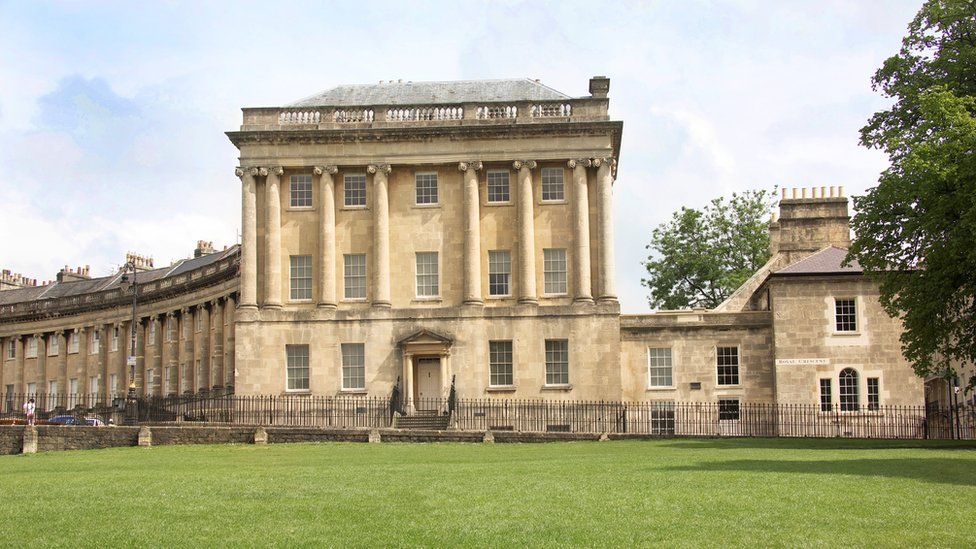
Although originally all town houses, many of the residences are now converted to flats. At the centre is the Royal Crescent Spa Hotel, occupying Nos. 16 & 17, while No. 1 has been a museum since the seventies. We visited the museum and found it most enjoyable. The visitor is taken through the house room by room accompanied by an audio & visual day in the life of the family members. These are a society family who have taken the house for the season; to take the waters and find the eldest daughter a rich husband. All very Jane Austen but enjoyable at the same time.

All buildings, and this is no exception, is about the people who live and use them. Amongst the notable people who have resided in the Crescent are Prince Frederick (hence the Royal suffix), both Thomas Woods and the Linley family. Thomas Linley was singing master and conductor and his family were subject of numerous Thomas Gainsborough portraits. His daughter, Elizabeth Linley, famously eloped with the actor & poet, Richard Sheridan. Others included Isaac Pitman, inventor of the Pitman Shorthand language.
Close by is the Circus, a circular array of town houses built by John Wood the Elder and the city is full of classical Georgian avenues all in Bath stone. None quite match the unique magnificence of the Royal Crescent though. See also my post on Work in Progress at Bath.
 White Box Art Channel
Beautiful post and images that bring back wonderful memories💙
LikeLike
Always enjoy being reminded of visits we have made in the past.
LikeLiked by 1 person
That is a real pleasure, isn’t it???
LikeLike
Beautiful Bath this building is outstanding and a joy to visit
Susie
LikeLike
Bath is always a joy to visit and seeing different places on each different visit. xx
LikeLike